PCEP-30-02 Brain Dumps - PCEP-30-02 Current Exam Content
Wiki Article
P.S. Free 2026 Python Institute PCEP-30-02 dumps are available on Google Drive shared by ValidVCE: https://drive.google.com/open?id=1vi-LMrwYZTJy1w2cEYAgzYXy3fJafgKC
Have you ever noticed that people who prepare themselves for Python Institute PCEP-30-02 certification exam do not need to negotiate their salaries for a higher level, they just get it after they are Python Institute PCEP-30-02 Certified? The reason behind this fact is that they are considered the most deserving candidates for that particular job.
Our PCEP-30-02 test prep is renowned for free renewal in the whole year. As you have experienced various kinds of exams, you must have realized that renewal is invaluable to PCEP-30-02 study materials, especially to such important PCEP-30-02 exams. And there is no doubt that being acquainted with the latest trend of exams will, to a considerable extent, act as a driving force for you to pass the exams and realize your dream of living a totally different life. So if you do want to achieve your dream, buy our PCEP-30-02 practice materials.
Python Institute PCEP-30-02 Current Exam Content, Study PCEP-30-02 Test
Our products are designed by a lot of experts and professors in different area, our PCEP-30-02 exam questions can promise twenty to thirty hours for preparing for the exam. If you decide to buy our PCEP-30-02 test guide, which means you just need to spend twenty to thirty hours before you take your exam. By our PCEP-30-02 Exam Questions, you will spend less time on preparing for exam, which means you will have more spare time to do other thing. So do not hesitate and buy our PCEP - Certified Entry-Level Python Programmer guide torrent.
Python Institute PCEP-30-02 Exam copyright Topics:
| Topic | Details |
|---|---|
| Topic 1 |
|
| Topic 2 |
|
| Topic 3 |
|
| Topic 4 |
|
| Topic 5 |
|
Python Institute PCEP - Certified Entry-Level Python Programmer Sample Questions (Q27-Q32):
NEW QUESTION # 27
A program written in a high-level programming language is called:
- A. a source code
- B. machine code
- C. the ASCI I code
- D. a binary code
Answer: A
NEW QUESTION # 28
What is the expected result of the following code?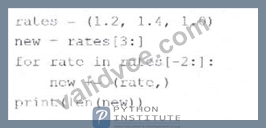
- A. 0
- B. 1
- C. The code will cause an unhandled
- D. 2
Answer: C
Explanation:
The code snippet that you have sent is trying to use a list comprehension to create a new list from an existing list. The code is as follows:
my_list = [1, 2, 3, 4, 5] new_list = [x for x in my_list if x > 5]
The code starts with creating a list called "my_list" that contains the numbers 1, 2, 3, 4, and 5. Then, it tries to create a new list called "new_list" by using a list comprehension. A list comprehension is a concise way of creating a new list from an existing list by applying some expression or condition to each element. The syntax of a list comprehension is:
new_list = [expression for element in old_list if condition]
The expression is the value that will be added to the new list, which can be the same as the element or a modified version of it. The element is the variable that takes each value from the old list. The condition is an optional filter that determines which elements will be included in the new list. For example, the following list comprehension creates a new list that contains the squares of the even numbers from the old list:
old_list = [1, 2, 3, 4, 5, 6] new_list = [x ** 2 for x in old_list if x % 2 == 0] new_list = [4, 16, 36] The code that you have sent is trying to create a new list that contains the elements from the old list that are greater than 5. However, there is a problem with this code. The problem is that none of the elements in the old list are greater than 5, so the condition is always false. This means that the new list will be empty, and the expression will never be evaluated. However, the expression is not valid, because it uses the variable x without defining it. This will cause a NameError exception, which is an error that occurs when a variable name is not found in the current scope. The code does not handle the exception, and therefore it will terminate with an error message.
The expected result of the code is an unhandled exception, because the code tries to use an undefined variable in an expression that is never executed. Therefore, the correct answer is D. The code will cause an unhandled exception.
Reference: Python - List Comprehension - W3SchoolsPython - List Comprehension - GeeksforGeeksPython Exceptions: An Introduction - Real Python
NEW QUESTION # 29
What is the expected result of the following code?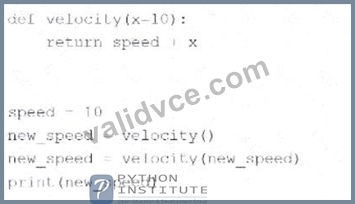
- A. 0
- B. 1
- C. 2
- D. The code is erroneous and cannot be run.
Answer: D
Explanation:
The code snippet that you have sent is trying to use the global keyword to access and modify a global variable inside a function. The code is as follows:
speed = 10 def velocity(): global speed speed = speed + 10 return speed print(velocity()) The code starts with creating a global variable called "speed" and assigning it the value 10. A global variable is a variable that is defined outside any function and can be accessed by any part of the code. Then, the code defines a function called "velocity" that takes no parameters and returns the value of "speed" after adding 10 to it. Inside the function, the code uses the global keyword to declare that it wants to use the global variable
"speed", not a local one. A local variable is a variable that is defined inside a function and can only be accessed by that function. The global keyword allows the function to modify the global variable, not just read it. Then, the code adds 10 to the value of "speed" and returns it. Finally, the code calls the function "velocity" and prints the result.
However, the code has a problem. The problem is that the code uses the global keyword inside the function, but not outside. The global keyword is only needed when you want to modify a global variable inside a function, not when you want to create or access it outside a function. If you use the global keyword outside a function, you will get a SyntaxError exception, which is an error that occurs when the code does not follow the rules of the Python language. The code does not handle the exception, and therefore it will terminate with an error message.
The expected result of the code is an unhandled exception, because the code uses the global keyword incorrectly. Therefore, the correct answer is A. The code is erroneous and cannot be run.
Reference: Python Global Keyword - W3SchoolsPython Exceptions: An Introduction - Real Python The code is erroneous because it is trying to call the "velocity" function without passing any parameter, which will raise a TypeError exception. The "velocity" function requires one parameter "x", which is used to calculate the return value of "speed" multiplied by "x". If no parameter is passed, the function will not know what value to use for "x".
The code is also erroneous because it is trying to use the "new_speed" variable before it is defined. The
"new_speed" variable is assigned the value of 20 after the first function call, but it is used as a parameter for the second function call, which will raise a NameError exception. The variable should be defined before it is used in any expression or function call.
Therefore, the code will not run and will not produce any output.
The correct way to write the code would be:
# Define the speed variable
speed = 10
# Define the velocity function
def velocity(x):
return speed * x
# Define the new_speed variable
new_speed = 20
# Call the velocity function with new_speed as a parameter
print(velocity(new_speed))
Copy
This code will print 200, which is the result of 10 multiplied by 20.
References:
[Python Programmer Certification (PCPP) - Level 1]
[Python Programmer Certification (PCPP) - Level 2]
[Python Programmer Certification (PCPP) - Level 3]
[Python: Built-in Exceptions]
[Python: Defining Functions]
[Python: More on Variables and Printing]
NEW QUESTION # 30
Assuming that the following assignment has been successfully executed:
My_list - [1, 1, 2, 3]
Select the expressions which will not raise any exception.
(Select two expressions.)
- A. my list [6]
- B. my_list|my_Li1st | 3| I
- C. my_list[-10]
- D. my_List- [0:1]
Answer: B,D
Explanation:
Explanation
The code snippet that you have sent is assigning a list of four numbers to a variable called "my_list". The code is as follows:
my_list = [1, 1, 2, 3]
The code creates a list object that contains the elements 1, 1, 2, and 3, and assigns it to the variable "my_list".
The list can be accessed by using the variable name or by using the index of the elements. The index starts from 0 for the first element and goes up to the length of the list minus one for the last element. The index can also be negative, in which case it counts from the end of the list. For example, my_list[0] returns 1, and my_list[-1] returns 3.
The code also allows some operations on the list, such as slicing, concatenation, repetition, and membership.
Slicing is used to get a sublist of the original list by specifying the start and end index. For example, my_list[1:3] returns [1, 2]. Concatenation is used to join two lists together by using the + operator. For example, my_list + [4, 5] returns [1, 1, 2, 3, 4, 5]. Repetition is used to create a new list by repeating the original list a number of times by using the * operator. For example, my_list * 2 returns [1, 1, 2, 3, 1, 1, 2, 3].
Membership is used to check if an element is present in the list by using the in operator. For example, 2 in my_list returns True, and 4 in my_list returns False.
The expressions that you have given are trying to access or manipulate the list in different ways. Some of them are valid, and some of them are invalid and will raise an exception. An exception is an error that occurs when the code cannot be executed properly. The expressions are as follows:
A). my_list[-10]: This expression is trying to access the element at the index -10 of the list. However, the list only has four elements, so the index -10 is out of range. This will raise an IndexError exception and output nothing.
B). my_list|my_Li1st | 3| I: This expression is trying to perform a bitwise OR operation on the list and some other operands. The bitwise OR operation is used to compare the binary representation of two numbers and return a new number that has a 1 in each bit position where either number has a 1. For example, 3 | 1 returns 3, because 3 in binary is 11 and 1 in binary is 01, and 11 | 01 is 11. However, the bitwise OR operation cannot be applied to a list, because a list is not a number. This will raise a TypeError exception and output nothing.
C). my list [6]: This expression is trying to access the element at the index 6 of the list. However, the list only has four elements, so the index 6 is out of range. This will raise an IndexError exception and output nothing.
D). my_List- [0:1]: This expression is trying to perform a subtraction operation on the list and a sublist. The subtraction operation is used to subtract one number from another and return the difference. For example, 3 - 1 returns 2. However, the subtraction operation cannot be applied to a list, because a list is not a number. This will raise a TypeError exception and output nothing.
Only two expressions will not raise any exception. They are:
B). my_list|my_Li1st | 3| I: This expression is not a valid Python code, but it is not an expression that tries to access or manipulate the list. It is just a string of characters that has no meaning. Therefore, it will not raise any exception, but it will also not output anything.
D). my_List- [0:1]: This expression is a valid Python code that uses the slicing operation to get a sublist of the list. The slicing operation does not raise any exception, even if the start or end index is out of range. It will just return an empty list or the closest possible sublist. For example, my_list[0:10] returns [1, 1, 2, 3], and my_list[10:20] returns []. The expression my_List- [0:1] returns the sublist of the list from the index 0 to the index 1, excluding the end index. Therefore, it returns [1]. This expression will not raise any exception, and it will output [1].
Therefore, the correct answers are B. my_list|my_Li1st | 3| I and D. my_List- [0:1].
NEW QUESTION # 31
How many hashes (+) does the code output to the screen?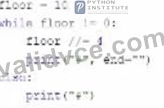
- A. three
- B. zero (the code outputs nothing)
- C. one
- D. five
Answer: D
Explanation:
Explanation
The code snippet that you have sent is a loop that checks if a variable "floor" is less than or equal to 0 and prints a string accordingly. The code is as follows:
floor = 5 while floor > 0: print("+") floor = floor - 1
The code starts with assigning the value 5 to the variable "floor". Then, it enters a while loop that repeats as long as the condition "floor > 0" is true. Inside the loop, the code prints a "+" symbol to the screen, and then subtracts 1 from the value of "floor". The loop ends when "floor" becomes 0 or negative, and the code exits.
The code outputs five "+" symbols to the screen, one for each iteration of the loop. Therefore, the correct answer is C. five.
NEW QUESTION # 32
......
Almost those who work in the IT industry know that it is very difficult to prepare for PCEP-30-02. Although our ValidVCE cannot reduce the difficulty of PCEP-30-02 exam, what we can do is to help you reduce the difficulty of the exam preparation. Once you have tried our technical team carefully prepared for you after the test, you will not fear to PCEP-30-02 Exam. What we have done is to make you more confident in PCEP-30-02 exam.
PCEP-30-02 Current Exam Content: https://www.validvce.com/PCEP-30-02-exam-collection.html
- Valid PCEP-30-02 Exam Cost ???? Practice PCEP-30-02 Exam Pdf ???? PCEP-30-02 Valid Exam Tips ???? Search for ⮆ PCEP-30-02 ⮄ on ➤ www.pass4test.com ⮘ immediately to obtain a free download ????PCEP-30-02 Exam Actual Questions
- PCEP-30-02 Latest Test Question ???? Vce PCEP-30-02 Exam ???? New PCEP-30-02 Test Materials ???? Download ➤ PCEP-30-02 ⮘ for free by simply searching on [ www.pdfvce.com ] ????Vce PCEP-30-02 Exam
- Marvelous PCEP-30-02 Brain Dumps for Real Exam ???? Open ☀ www.practicevce.com ️☀️ and search for ➽ PCEP-30-02 ???? to download exam materials for free ????Practice PCEP-30-02 Exam Pdf
- PCEP-30-02 Actual Exam ???? Vce PCEP-30-02 Exam ???? PCEP-30-02 Exam Actual Questions ???? Go to website ➽ www.pdfvce.com ???? open and search for ( PCEP-30-02 ) to download for free ⛅New PCEP-30-02 Test Materials
- Python Institute Offers Many Features For Python Institute PCEP-30-02 Exam Preparation ???? Go to website ✔ www.prep4away.com ️✔️ open and search for ( PCEP-30-02 ) to download for free ????PCEP-30-02 Exam Vce Free
- New PCEP-30-02 Test Materials ???? PCEP-30-02 Valid Test Topics ???? Latest PCEP-30-02 Test Practice ???? Enter ➽ www.pdfvce.com ???? and search for ☀ PCEP-30-02 ️☀️ to download for free ????New PCEP-30-02 Test Materials
- PCEP-30-02 Latest Questions ???? PCEP-30-02 Actual Exam ???? PCEP-30-02 Actual Exam ???? Search on ▛ www.dumpsmaterials.com ▟ for { PCEP-30-02 } to obtain exam materials for free download ????New PCEP-30-02 Test Materials
- Clearing Exam isnt Difficult with Real Python Institute PCEP-30-02 Questions ???? Search for ( PCEP-30-02 ) and download it for free on ➽ www.pdfvce.com ???? website ????New PCEP-30-02 Exam Dumps
- PCEP-30-02 Customizable Exam Mode ???? PCEP-30-02 Reliable Exam Price ???? PCEP-30-02 Practice Exams Free ???? Search for ➠ PCEP-30-02 ???? and obtain a free download on ☀ www.exam4labs.com ️☀️ ????PCEP-30-02 Reliable Exam Price
- PCEP-30-02 Reliable Test Topics ???? PCEP-30-02 Practice Exams Free ???? New PCEP-30-02 Exam Dumps ???? Open website ➡ www.pdfvce.com ️⬅️ and search for ➡ PCEP-30-02 ️⬅️ for free download ↖Practice PCEP-30-02 Exam Pdf
- Pass Guaranteed Quiz PCEP-30-02 - PCEP - Certified Entry-Level Python Programmer Pass-Sure Brain Dumps ???? Enter ☀ www.troytecdumps.com ️☀️ and search for ( PCEP-30-02 ) to download for free ⛅PCEP-30-02 Customizable Exam Mode
- mattieupfj116360.wikigiogio.com, cecilykwkr552496.blogdemls.com, junaidmasf753196.blogproducer.com, heathasmr336318.elbloglibre.com, albertarqt812297.get-blogging.com, ledbookmark.com, barryvzgx275404.wikilinksnews.com, jasonskvx059432.muzwiki.com, orangebookmarks.com, ehoroskop.net, Disposable vapes
P.S. Free 2026 Python Institute PCEP-30-02 dumps are available on Google Drive shared by ValidVCE: https://drive.google.com/open?id=1vi-LMrwYZTJy1w2cEYAgzYXy3fJafgKC
Report this wiki page